

How rising bond yields are shaping the market outlook
- 09.25.26
- Markets & Investing
- Commentary
Review the latest Weekly Headings by CIO Larry Adam.
Key takeaways:
- The resilient economy is facing a more challenging forecast
- Equity market shows calm skies above, but choppier waters below
- Although the Treasury storm is intensifying, credit holds firm
The financial markets are navigating a storm. The Treasury yield sell-off intensified this week, pushing the 10-year Treasury yield up to an intraday high of 5.20%, its highest level since 2007. Stronger than expected economic data and growing expectations that interest rates may remain higher for longer are beginning to test investors' resolve. While higher yields reflect an economy that has proven remarkably resilient, they also pose a growing challenge for consumers, businesses and financial markets alike. Below, we examine how the surge in bond yields is shaping the economic outlook, influencing fixed income and equity markets and creating greater dispersion beneath the surface.
Resilient economy faces a more challenging forecast
The US economy has weathered a cooling labor market, rising trade tensions and the recent energy shock remarkably well. Growth has remained resilient, supported by the AI investment boom, recent tax relief and the spending power of higher-income consumers despite elevated energy costs.
For now, there is little evidence the expansion is at risk. Real-time indicators, including Redbook retail sales, restaurant bookings, hotel occupancy and other measures of consumer activity, remain healthy while bank executives continue to express confidence in the overall consumer.
However, that resilience may soon face a more meaningful test. With no end in sight to the US-Iran conflict, oil and diesel prices near record levels and interest rates at multi-decade highs, pressure is building beneath the surface.
While the AI buildout and affluent consumers remain important sources of support, middle- and lower-income households are feeling increasingly squeezed. Higher rates are raising borrowing costs across mortgages, home equity loans, auto financing and credit cards, creating headwinds for housing activity and consumer spending.
At the same time, elevated energy prices are putting added strain on household budgets just as the fiscal boost has faded and the savings rate remains near a four-year low. With those buffers dwindling, the economy is becoming increasingly reliant on higher-income consumers, placing greater importance on holiday spending trends and the durability of consumer demand heading into the critical holiday shopping season.
Equity market shows calm skies above, choppier waters below
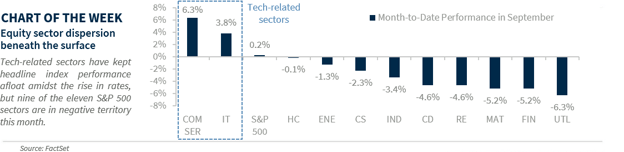
Despite a sharp rise in interest rates, US equities at the headline level have shown impressive resilience. The 10-year Treasury yield has climbed 43 basis points month to date, putting it on track for its largest monthly increase since October 2024, yet the S&P 500 is up 0.2% month to date and sits just 1% below its all-time high.
At the same time, volatility remains subdued with the VIX hovering near 15. Much of that strength has been concentrated in communication services and technology, which have gained 6% and 4% month to date, as AI-driven growth themes have largely shrugged off higher interest rates.
Beneath the surface, however, the market tells a different story. Nine of the eleven sectors are negative month to date, while 75% of S&P 500 constituents have declined, marking the highest share of falling stocks during a positive month for the index in at least 20 years.
Rate-sensitive areas have borne the brunt of the pressure. Utilities (-6.3%), financials (-5.2%) and real estate (-4.6%) have lagged amid rising yields and a flatter yield curve, while the Russell 2000 remains approximately 8% below its recent high. Small-cap companies are particularly exposed, with 54% of their debt tied to short-term floating rates.
While higher rates are likely to widen the gap between winners and losers, corporate fundamentals remain a key source of support. Interest expense as a share of corporate profits is still near 50-year lows, and forward profit margin estimates continue to reach new highs. As a result, earnings should remain healthy despite higher borrowing costs, supporting our constructive longer-term outlook for equities.
The Treasury storm intensifies, while credit holds firm
Despite the steady climb in Treasury yields, credit markets are showing surprisingly few signs of stress. The 10-year Treasury yield has risen approximately 80 basis points over the past three months, from 4.37% to 5.20%, with much of that move occurring over the last few weeks.
Even so, the adjustment has remained largely orderly. While the BofA MOVE Index, the bond market's version of the VIX, surged more than 20% on Wednesday, its biggest one-day jump since 1990, credit investors have remained largely unfazed. In fact, credit markets continue to display impressive resilience.
Investment-grade and high-yield spreads remain near multi-year tights at 77 and 282 basis points, respectively, suggesting investors see little evidence of a meaningful deterioration in either the economy or corporate fundamentals. Similar to the growing divide within equities, any weakness has been concentrated among lower-quality borrowers.
The spread differential between CCC- and BB-rated debt has widened to 787 basis points, its highest level since the Federal Reserve's 2022 tightening cycle. Importantly, that pressure remains confined to the weakest credits rather than signaling broader market stress. Instead, it suggests investors are becoming more selective as higher rates begin to test the most leveraged and economically sensitive borrowers.
Bottom line
Despite a sharp rise in interest rates, the economy and financial markets have remained remarkably resilient. However, mounting rate pressures are creating greater dispersion beneath the surface, a trend we expect to continue until rates stabilize.
All expressions of opinion reflect the judgment of the author(s) and the Investment Strategy Committee and are subject to change. This information should not be construed as a recommendation. The foregoing content is subject to change at any time without notice. Content provided herein is for informational purposes only. There is no guarantee that these statements, opinions or forecasts provided herein will prove to be correct. Past performance is not a guarantee of future results. Indices and peer groups are not available for direct investment. Any investor who attempts to mimic the performance of an index or peer group would incur fees and expenses that would reduce returns. No investment strategy can guarantee success.
Economic and market conditions are subject to change. Investing involves risks including the possible loss of capital.
The information has been obtained from sources considered to be reliable, but we do not guarantee that the foregoing material is accurate or complete. Diversification and asset allocation do not ensure a profit or protect against a loss.
The S&P 500 Total Return Index: The index is widely regarded as the best single gauge of large-cap U.S. equities. There is over USD 7.8 trillion benchmarked to the index, with index assets comprising approximately USD 2.2 trillion of this total. The index includes 500 leading companies and captures approximately 80% coverage of available market capitalization.
Sector investments are companies focused on a specific economic sector and are presented here for illustrative purposes only. Sectors, including technology, are subject to varying levels of competition, economic sensitivity, and political and regulatory risks. Investing in any individual sector involves limited diversification.
